Showing posts with label how to. Show all posts

Friday, September 18, 2015

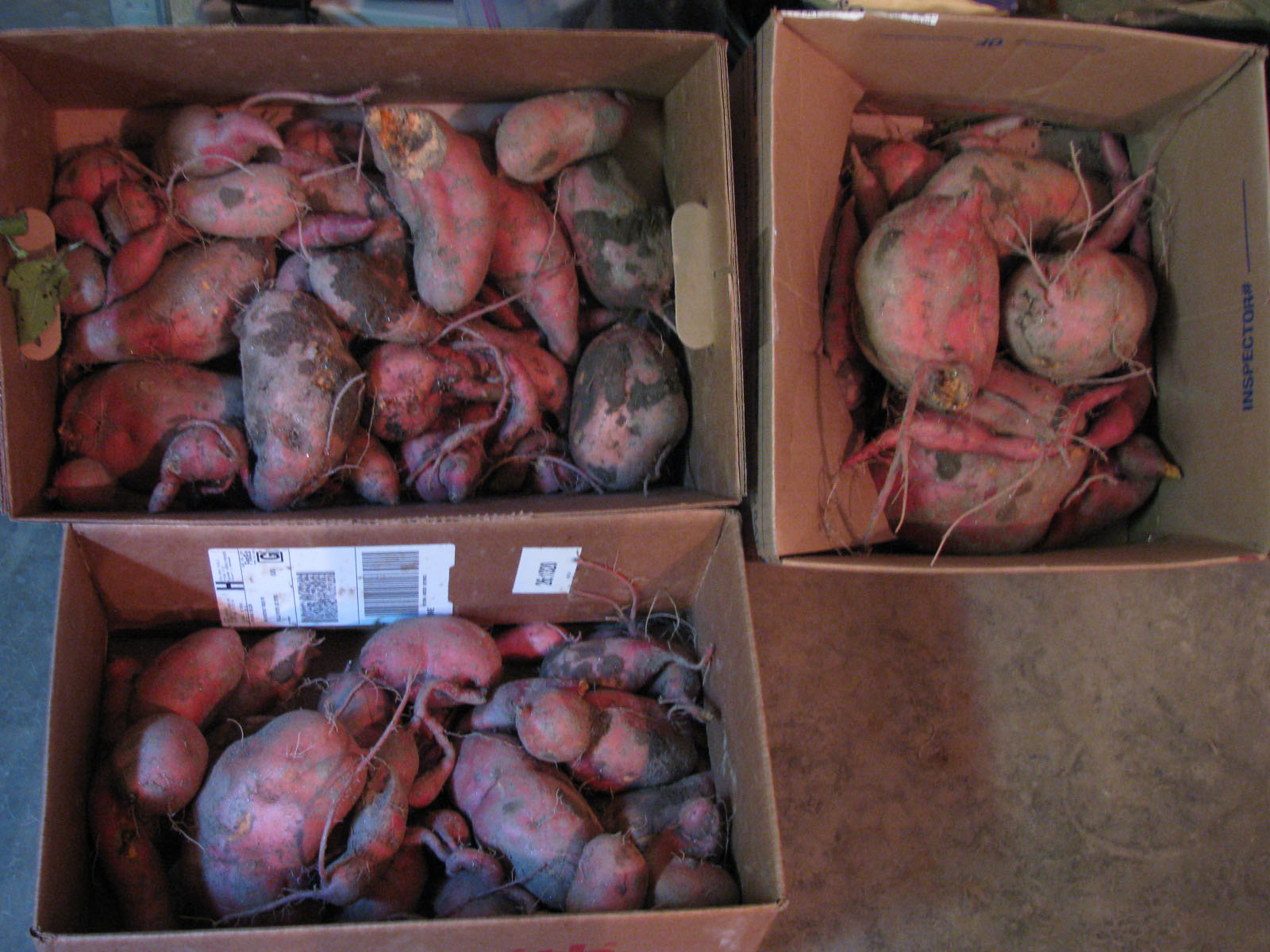
Harvesting and Curing Sweet Potatoes

It's TimeTo Dig for Gold!


When to Harvest Sweet Potatoes?
Gardeners in North Carolina, the biggest sweet potato-producing state, time their plantings so the roots will mature by late September and early October. This gives them time to harvest before the first frost, so the potatoes are in storage as the weather turns cool.
Frost and cold weather can hurt sweet potatoes at harvesttime even though you might think they're insulated underground. When frost kills and blackens the vines aboveground, decay can start in on the dead vines and pass down to the roots. If your sweet potato plants suffer a frost one night, cut the vines off right above the soil first thing the next morning. This may let you leave the potatoes in the ground for a few more days without injury.
Try to dig the sweet potatoes on a dry, overcast day. Leaving them in direct sun for long can open pathways of infection that will damage the crop in storage. Dig gently around the hills, starting from a few feet away, so as not to slash any wandering roots with your shovel or fork.
Let the potatoes dry on the ground for a couple of hours. If you dig late in the day, don't leave the roots out overnight; you risk damage from cold weather and moisture. Don't wash the potatoes after the harvest, either. Sort any badly cut or bruised potatoes to eat first (they won't keep) and sort the rest according to size in boxes or baskets to cure before storage.
Let Them Cure
Curing can be done in 10 to 14 days by keeping sweet potatoes in a warm, dark place with some ventilation. The temperature should be 80 deg to 85 deg F with high humidity. Under these conditions, bruises and wounds will heal quickly, sealing out rot organisms.
After curing, put the containers of sweet potatoes in a dry, well-ventilated area at 55 deg to 60 deg F with a relative humidity of 75 percent to 80 percent. Under ideal conditions, you can keep a mature crop until the next early harvest. If you can't store your sweet potatoes under these conditions, you may want to cook and freeze your harvest.
Sweet potatoes bruise easily and can suffer quickly when handled in storage. It's best not to pick through them too often.

Wednesday, May 16, 2012

Saving Energy in the Garden

Don't be mislead, you probably know my values well-enough by now to realize that "energy" in the title of this post means "net energy" expended - human and other.

Here are energy saving tips excerpted from the latest Sundance Power Systems newsletter.

Some tips to save energy in the garden this year:
  • Plant natural grasses and shrubs that are native to your area and do not require a lot of extra water in the summer.
  • Plant shade trees in the yard, by roadways and in vacant lots to combat the rising CO2 production.
  • Plant native wildflowers in vacant lots, roadsides and other public areas so that the grass will not have to be mowed as often.
  • Collect rain water in a rain barrel or cistern for watering plants, garden and landscaping.
  • Looking for an easy way to save energy? Reduce your landscape watering schedule. Experts say that most yards are over-watered.
  • Water lawns early in the morning and long enough for a deep soak to encourage deep root growth.
  • Plants and grasses grow slowly in the cooler weather. Reduce your watering schedule accordingly.
  • Keep an eye on the weather report and turn off your automatic irrigation system when rain is predicted. Keep it off for a week after the rain stops. Even longer in the winter.
  • As a general rule, lawns only need watering every 5 to 7 days in the summer and every 10 to 14 days in the winter. A hearty rain eliminates the need for watering for as long as two weeks.
  • Check your sprinkler system and timer on a regular basis to be sure it is operating properly and giving you the right coverage.
  • Install a rain sensor device or switch which will override the irrigation cycle of the sprinkler system when adequate rainfall has occurred.
  • Use a "soaker" hose rather than a sprinkler, where possible. Less water is required because the water is concentrated on the soil nearer the roots and there is less evaporation.
  • Water in the early morning or late afternoon to avoid evaporation. Avoid watering on windy days.
  • Convert to a drip irrigation system that waters specific plants and avoids water waste.
  • Looking for ways to save energy? Use electric instead of gas powered lawn and garden equipment, as they create less pollution and are usually more energy efficient.
  • Buy a new push mower for your lawn. They are quiet, non-polluting and you won't have to drive to the gym.
  • Use "hand" pruners, clippers and other yard tools rather than gasoline or electric-powered ones.
  • One idea on how to save energy is to keep the cutting edges sharp on your gasoline and electric-powered yard equipment. The equipment will cut more efficiently and use less energy.
  • Also, dull cutting edges tend to fray grass blades and increase water evaporation from the grass plants.
  • If you reduce fertilizing the lawn, you'll have to water less and cut the it less frequently.
  • Raise the lawn mower blade to at least three inches. A lawn cut higher encourages grass roots to grow deeper, shades the root system and holds soil moisture better than a closely-clipped lawn.
  • Leave lawn clippings after mowing to fertilize the grass, or collect the clippings and use them for mulch.
  • You can save money and do your lawn a favor by using a mulching lawn mower instead of bagging and carting off grass clippings. The mulched clippings fall back to the soil and add nutrients.
  • Mulch your planting beds to retain moisture in the soil. Mulching also helps to control weeds that compete with plants for water.
  • Use a broom to clean the sidewalks and driveway. Using a hose to clean these surfaces wastes hundreds of gallons of water.
  • Sweeping the sidewalks and driveway instead of using a noisy, polluting, blower is a good tip on how to save energy.
  • Regularly check all hoses, connectors and spigots for leaks. Install new hose washers when needed.
  • Plant native plants that are adapted to your area. They require less water and maintenance, and look great.
  • If possible, use the grey water from the laundry and shower for irrigation in the yard.
  • Choose the small solar powered lights for your landscape lighting. They're easy to find online or in garden stores and are just one way how to save energy in the garden.

Sunday, May 13, 2012

Working Together to Conquer Waste

This is a great idea - The Repair Cafe. Take a look at the description as reported in the NY Times and let's consider doing one or more of these at High Vista in the near future. Perhaps we can incorporate it into our winter Community Connections Salon Series. If you're interested, let me know.
Summary: "At Amsterdam’s first Repair Cafe, an event originally held in a theater’s foyer, then in a rented room in a former hotel and now in a community center a couple of times a month, people can bring in whatever they want to have repaired, at no cost, by volunteers who just like to fix things. 
Conceived of as a way to help people reduce waste, the Repair Cafe concept has taken off since its debut two and a half years ago. The Repair Cafe Foundation has raised about $525,000 through a grant from the Dutch government, support from foundations and small donations, all of which pay for staffing, marketing and even a Repair Cafe bus. 
Thirty groups have started Repair Cafes across the Netherlands, where neighbors pool their skills and labor for a few hours a month to mend holey clothing and revivify old coffee makers, broken lamps, vacuum cleaners and toasters, as well as at least one electric organ, a washing machine and an orange juice press."